INVITATION: Imagining a collaborative research ecosystem in service of the regeneration of Greater Melbourne
Why it matters
The global and local pressures on our planetary boundaries and social foundation call for challenge-led collaborative research practices that better respond and adapt to the urgency, scale and complexity of the challenges we face, and which show up in Greater Melbourne. There is a need to transcend organisational and disciplinary boundaries, to find new and inclusive ways to support the activation of research and sharing of knowledge and diverse perspectives in service of Greater Melbourne.
Our world is changing at a rapid pace. More than ever, we need to strengthen our ability to make strategic long-term choices while adequately responding to the scale and pace of near-term responses required on the ground. Our academic system and the ways in which research is conducted, measured and resourced towards this purpose must also adapt.
According to Australia’s Chief Scientist’s 2023 report, the current practices for assessing research careers do not promote innovative and multi-disciplinary research in Australia. For scholars, academic competency is still primarily measured by the number of peer-reviewed publications, citations and h-index. This results in immense pressures to publish through academic channels, which is linked to researchers’ capacity to attract funding and, often, access precarious and limited career opportunities and progression. From a civic society’s perspective, most academic articles are not accessible and do not meet the needs of civil society. These articles are often hidden behind paywalls, slow to move through the publication process and are written in technical language that requires translation to become applied.
At the same time, democratising understanding, forms and holders of knowledge is paramount. This is in a context where the rising tuition costs and the perceived corporatisation of Australian universities have led to a sharp decline in public trust in universities, associated with concerns about the accessibility and relevance of higher education.
We are in a state of transition and the decisions we make today have implications for tomorrow. We have the agency and responsibility to imagine and create better futures together, today. With unknown futures and unclear pathways forward, what we need most is to build our collective capacity to navigate and adapt to changing conditions. Activating collaborative research practices and knowledge flows can help us do so. The seeds of the future are already in the ground and some will flourish with the right set of nutrients, care, water and light.
The Opportunity
Imagine…
…if universities were civic spaces: sites for society’s most pressing questions to be rigorously interrogated with public purpose, care for people and the planet, at the heart of everything.
…a research ecosystem with collaborative, inclusive and diverse environments for knowledge co-production as shared infrastructure, oriented towards challenge-led governance and innovation.
…if researchers and practitioners were sustainably supported to join perspectives and forces to work, learn and adapt together to fairly address the pressing challenges of our time?
At Regen Melbourne, we don’t know what the future entails, nor the exact shape of a collaborative research ecosystem that would be in service of the regeneration of Greater Melbourne. But we are experimenting with different ways of imagining, doing and supporting collaborative research practices to get Greater Melbourne closer to the safe and just space within our planetary boundaries and social foundation. We know that a lot of people care, yet sometimes feel isolated in their efforts. We know that impactful research practices exist in community, in industry, in policy contexts, in think-tanks, in not-for-profits, in community service organisations and in academic settings. This is not new or ground-breaking; indeed, researchers in Melbourne have directly acknowledged the need to extend research impact as ethos and culture. Academics for Public Universities have also written extensively on the destruction of the Australian Academic community, culture and workplace. But this is also not just about the academic sector or pure theory: we know that valuable knowledge, experience and practice exist in communities and industry. Together, we have an opportunity to align forces, imagine and shape brighter futures for a collaborative research ecosystem in service of Greater Melbourne.
Transitioning to what could be…
According to Mariana Mazzucato, responding to the grand societal challenges and opportunities of our time requires goal-driven innovation and multi-stakeholder cooperation across sectors and groups. This is where ‘mission-led’ or - more appropriately framed in the Australian colonial context: ‘challenge-led’ innovation - comes in. For Burkett and Hannant, “mission-led approaches provide us with an architecture to conceptualise and orchestrate movements for intentional, systemic and structural change.” These call for systemic investment and the supporting capital and orchestration infrastructure that moves away from a project-by-project mentality to a strategic portfolio approach (Transformation Capital, Hofstetter). Recognising the interconnections of challenges and focusing on the leverage points which aim to respond to multiple challenges at once also calls for adaptive governance. This is an essential component of urban experimentation and transitions that actively broaden our understanding of knowledge holders and through collaborative research practices and ecosystems that embed flexibility, evaluation and learning (The Experimental City, Drift for transition).
Australia’s gross expenditure on research and development, by business, government, higher education and private non-profit sectors, was estimated at $38.8 billion and 1.68% of gross domestic product in 2021-2022. For the high-income country that Australia is, ranking as the ninth richest economy per capita, this figure is shockingly below the Organisation for Economic Co-operation and Development (OECD) average of 2.7%.
Currently in Australia, the two biggest funders of research grants from 2015-24 were the National Health and Medical Research Council (NHMRC) and the Australian Research Council (ARC), with US$7.2 billion and US$6.3 billion of grant funding, respectively; with the majority (US$9 billion) of this funding dedicated to research in the biomedical and clinical sciences.
Although the Australian federal government describes the National Science and Research priorities as ‘challenge-based’, it is not entirely clear which collaborative research structures, mechanisms and practices currently address and support these priorities. With the exception of the Cooperative Research Centres (CRC) grants, current mechanisms for industry-led research collaborations largely focus on green technology development (e.g. Australian Renewable Energy Agency, Australian Economic Accelerator). Indeed, an examination of research and development in the 2024 federal budget highlights the technology-centric understanding and measurement of industry-research collaborations in the Australian innovation ecosystem, yet to reach the maturity of the international landscape where transdisciplinary and community-led practices and processes are more widely supported. Similarly, a strongly directed industry policy such as a Future Made in Australia has the potential to not only be a significant driver for R&D spend, and should seek a systems-based approach that would see a richer understanding of 'industry', one that is transdisciplinary and includes community-oriented perspectives.
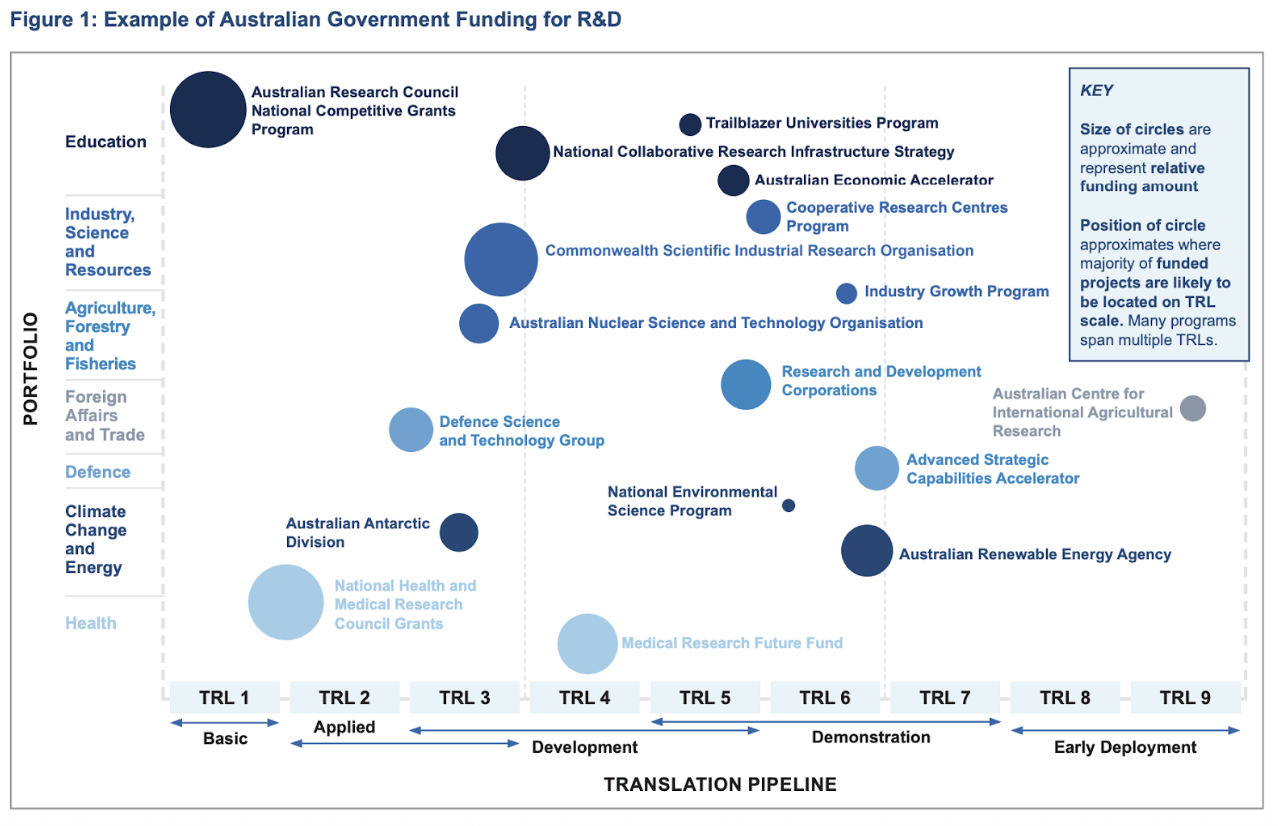
Often, for industry-research collaborations outside of the commercial technology mold, a handful of mechanisms, such as ARC Linkage grants or Fellowships, are the default funding pathways pursued. However, these programs are both highly competitive and not always structurally well-suited to the questions at hand. As such, there is a gap in resourcing opportunities and critical social and environmental needs to be addressed. Recognising the need for reforms, the Australian research sector conducted a review of the National Competitive Grants Program (NCGP). The resulting Policy Review Paper proposes a 20 year plan to “[support] excellent Australian-led research for the benefit of all Australians in decades to come”. Only time will tell how national research priorities and reforms translate in terms of capital flowing to challenge-based innovation. Will these reforms help broaden understanding of collaborative research practice and capacity of these mechanisms to adapt to changing conditions?
Although it is fair to say that the Australian innovation ecosystem lags behind the international arena, bright spots of challenge-based collaborative research and implementation do exist locally. We can also turn internationally for inspiration.
Water Sensitive Cities Cooperative Research Centre (WSCCRC) - Established in 2012, the Australian research centre brought together many disciplines, world-renowned subject matter experts, and industry leaders who wanted to revolutionise urban water management in Australia and overseas. Water Sensitive Cities Australia (WSCA), a multidisciplinary research-to-practice partnership within the Monash Sustainable Development Institute, continues the mission of the WSCCRC.
Planetary Civics - Led by Melbourne-based RMIT and UK-based Dark Matter Labs, this international initiative seeks to ‘address the urgent need for effective planetary-level governance that can safeguard interconnected living systems and their entanglements’. Planetary Civics recognises the need for collaborative and innovative approaches to governance, transcending traditional boundaries and paradigms to face planetary challenges.
Living Labs - The European Network of Living Labs (ENoLL) describes living labs as ‘open innovation ecosystems in real-life environments based on a systematic user co-creation approach that integrates research and innovation activities in communities and/or multi-stakeholder environments, placing citizens and/or end-users at the centre of the innovation process.’ They foster co-design and experimentation approaches among citizens, government, industry and academia.
CIVIC SQUARE - After more than a decade of organinising in its home city of Birmingham (UK), CIVIC SQUARE is demonstrating neighbourhood-scale civic infrastructure for social, ecological, economic, and climate transition.
European Institute of Innovation - Knowledge and Innovation Communities (EIT-KICs) - EIT-KICs enable systems level change all across Europe. EIT-KICs are Europe-wide networks centred around addressing a specific societal challenge through partnerships of higher education institutions, research centres, business and investors, and public and non-profit organisations.
Horizon Europe is the EU’s key funding programme, with a EUR 93.5 billion envelope between 2021-2027. It facilitates collaboration and strengthens the impact of research and innovation in developing, supporting and implementing EU policies while tackling global challenges, such as climate change. In the context of Australian universities losing funding from the US under the Trump administration “America First” agenda, Universities Australia is calling on the Australian Government to sign up to Horizon Europe to ‘help build Australia’s economic resilience in a rapidly changing global environment’. In a promising step forward, the EU and Australia have now started exploratory talks on association with Horizon Europe.
Despite some strides by CSIRO’s Research Programs, nothing of the scale or ambition of Horizon Europe currently exists in the Australian innovation ecosystem. What might it take to reimagine and experiment with alternative research infrastructure models that leverage cities as social laboratories that centre the agency of people and planet, and bring a diversity of disciplines, contexts and perspectives to collaborate?
Experimenting
At Regen Melbourne, we’re made up of an alliance of partners, including many researchers and practitioners who coalesce towards a collective vision for a regenerative Greater Melbourne and place-based pathways for creating alternatives to the current status quo. Since its early formation in 2020, Regen Melbourne has evolved from a community-led research experiment to a platform for collaboration. We host a portfolio of action-research projects designed to facilitate near-term change while also shifting the conditions needed for long-term, systemic change in service of the regeneration of Greater Melbourne. Our collective vision, portfolio of Earthshots and Systems Lab constitute a declaration of intent to solve complex social and ecological challenges, with approaches that transcend sectors and centre collective responses. The structure of our work draws directly from challenge-led innovation and associated frameworks and practices.
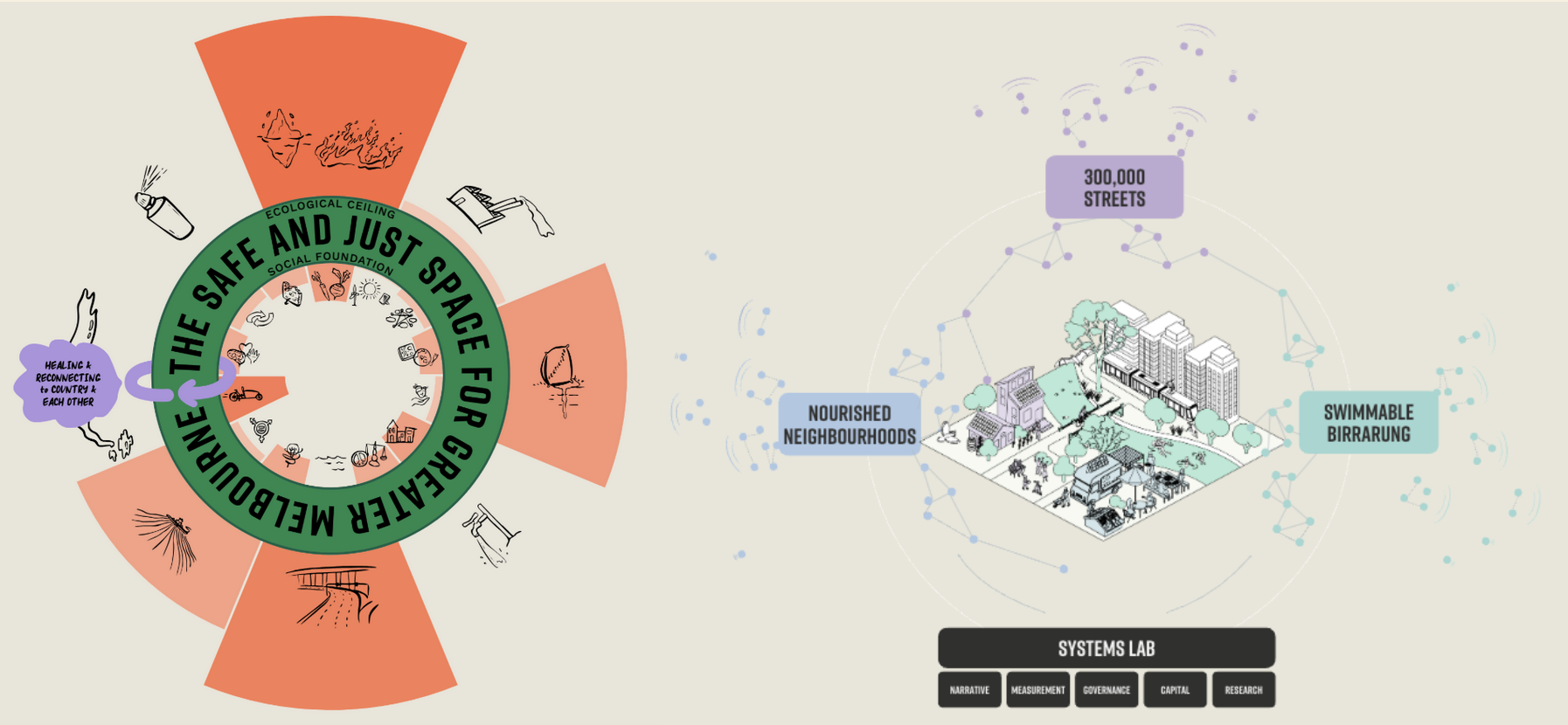
Our range of collaborative research practices and experiments vary in size, scale and timeframe. Let’s take the Swimmable Birrarung Earthshot to help us dive into a few examples.
Challenge-led innovation. Making the Birrarung River thriving and swimmable from source to sea is the orientation guiding a portfolio of interventions and collaborators in service to addressing this challenge.
Adaptive governance. A group of Earthshot Stewards, with representatives from diverse sectors integral to transforming the river: technological, government, community organisations, business, catchment management and urban transition research constitute the brains trust in service of the Swimmable Birrarung vision. The action-research agenda on the river is also guided and supported by our Research Council, an advisory group with representatives in relevant fields across seven partner universities. Altogether, this governance structure brings a breadth of cross-sectoral experience, knowledge, skills and connections - inclusive of research expertise - in service of the Earthshot’s purpose and transition pathways.
Systemic investment. We embarked on an exploration of the role of financial capital in the regeneration of our city in 2023. Using the Swimmable Birrarung Yarra River as a case study, our team conducted foundational research on the nature and quality of capital flows around the river. As a result, we proposed a formal collaboration - Melbourne Invests for Systemic Transformation (MIST) - dedicated to nurturing a paradigm shift in purpose-led capital and actively prototyping investment vehicles at the intersection of systems thinking and finance, emerged. As the first specific experiment within this frame, we’re currently developing mechanisms to support more systemic investment along the Birrarung (RiverBank).
Collaborative research practice. Through relational work, we have planted multiple seeds of collaborative research practice which have flourished over time as a range of research and teaching collaborations in service to the Birrarung. These include student work placements, challenge-led course development, storytelling partnership featuring the Birrarung, research partnerships and events organised as part of Riverfest. For example, through a collaboration with OPTIMA and Monash University on the role of optimisation for the Birrarung and how it can be used to support decision making, governance and education, a new PhD candidate is now part of Regen Melbourne’s team. We recently had a Monash intern undertake a literature review and mapping, connecting stormwater and the health of the Birrarung. This work is now serving as the foundation for other student placements focused on existing strategies and infrastructure supporting the health of the Birrarung. Through the Climate Change Exchange, we are bringing together research, policy and practice to build our collective capacity to adapt to climate change risks and impacts. We are working with WonderLab on reimagining our connection with a climate-resilient Birrarung. With La Trobe University and Swinburne University of Technology, we have identified the opportunity and need for centring the river as the subject of adaptation, mapping the systemic risks to the river and estimating the cost of regeneration.
Although we strive for systemic change, we understand that the work, including our relationship with research, is non-linear and requires us to dance across horizons:
intentionally doing what is possible within the current paradigm, constraints and existing mechanisms, including understanding current research incentive structures and funding mechanisms (H1),
seeking to shift the baseline towards more collaborative ways of organising research and researchers in service of the public good, better aligning research incentives and resourcing with social and ecological needs (H2),
and whenever possible showcasing how we may bring regenerative futures into the present (H3).
Here’s a non-exhaustive view of the seeds we are planting: the types of research interventions we are testing and exploring, across horizons. These are represented in a gradient of green to reflect the intentionality and emergent nature of regenerative futures in present activities:
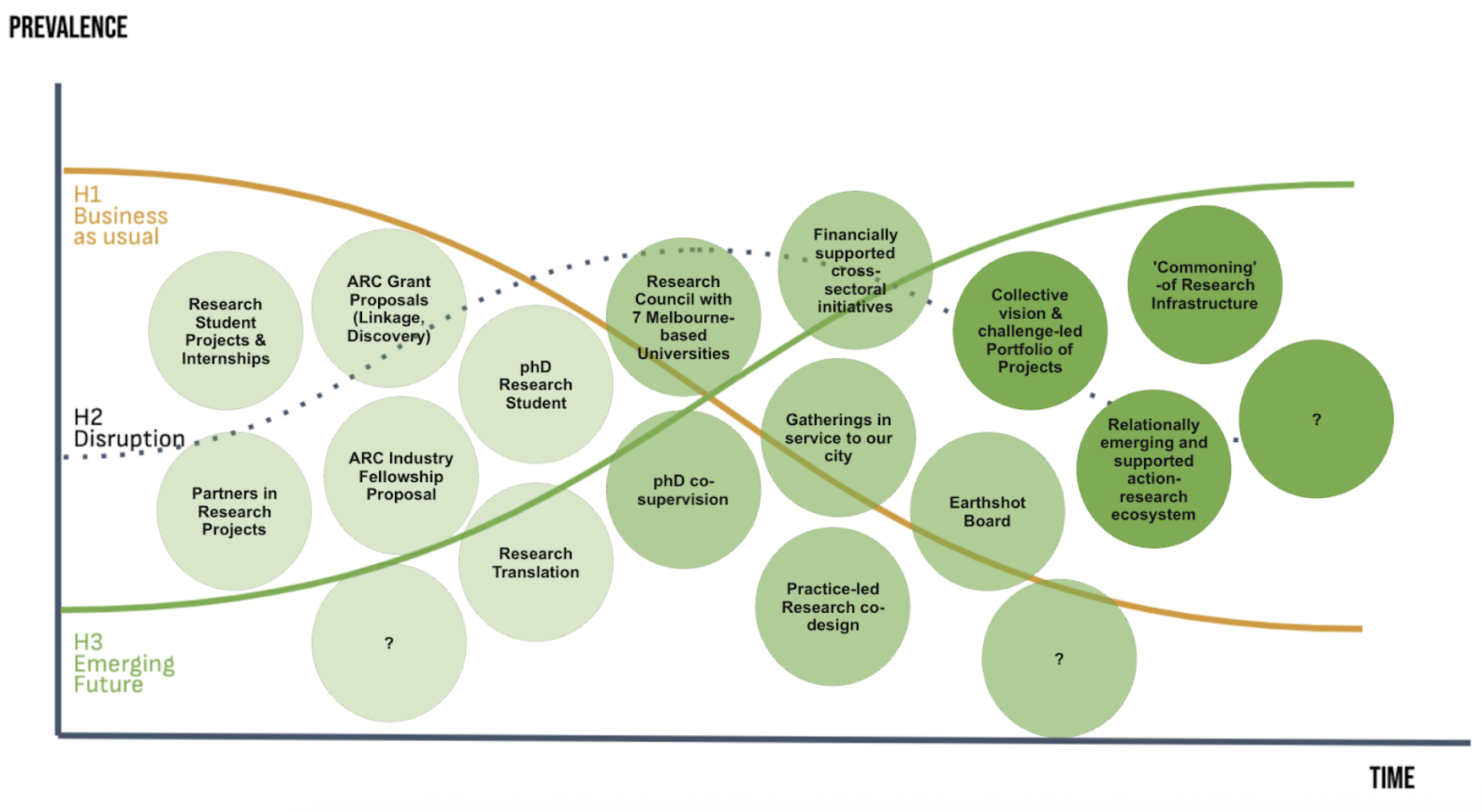
Examples of collaborative research practices at Regen Melbourne
The Invitation
With our Earthshots and Systems Lab, we are uniquely positioned to:
Provide a sandpit for imagining, experimenting and learning with challenge-led collaborative research practices,
Develop and demonstrate new connections, networks and partnership models transcending boundaries and disciplines, for a research ecosystem and funding in service to the regeneration of Greater Melbourne,
Establish an impact and learning framework informed by both practice and theory to translate and share experiment learnings to other contexts and help address the urgent challenges of our time.
Much more is needed, so we're launching a call to develop a coalition of the willing to explore new forms of collaborative research. We invite you to explore, experiment and learn with us what it might take to foster more collaborative research practices in service to the regeneration of Greater Melbourne.
We certainly don’t have all the answers, but we have questions. We also have an ambitious sandbox and are surrounded by great thinkers and doers, across institutions, disciplines and sectors, who want to create positive change.
Would you like to be part of a coalition imagining brighter futures for collaborative research practices in service of Greater Melbourne and unlocking pathways to get us there?
Contact Yasmina at yasmina@regen.melbourne.