
How is Melbourne citizening? A street tour with Jon Alexander
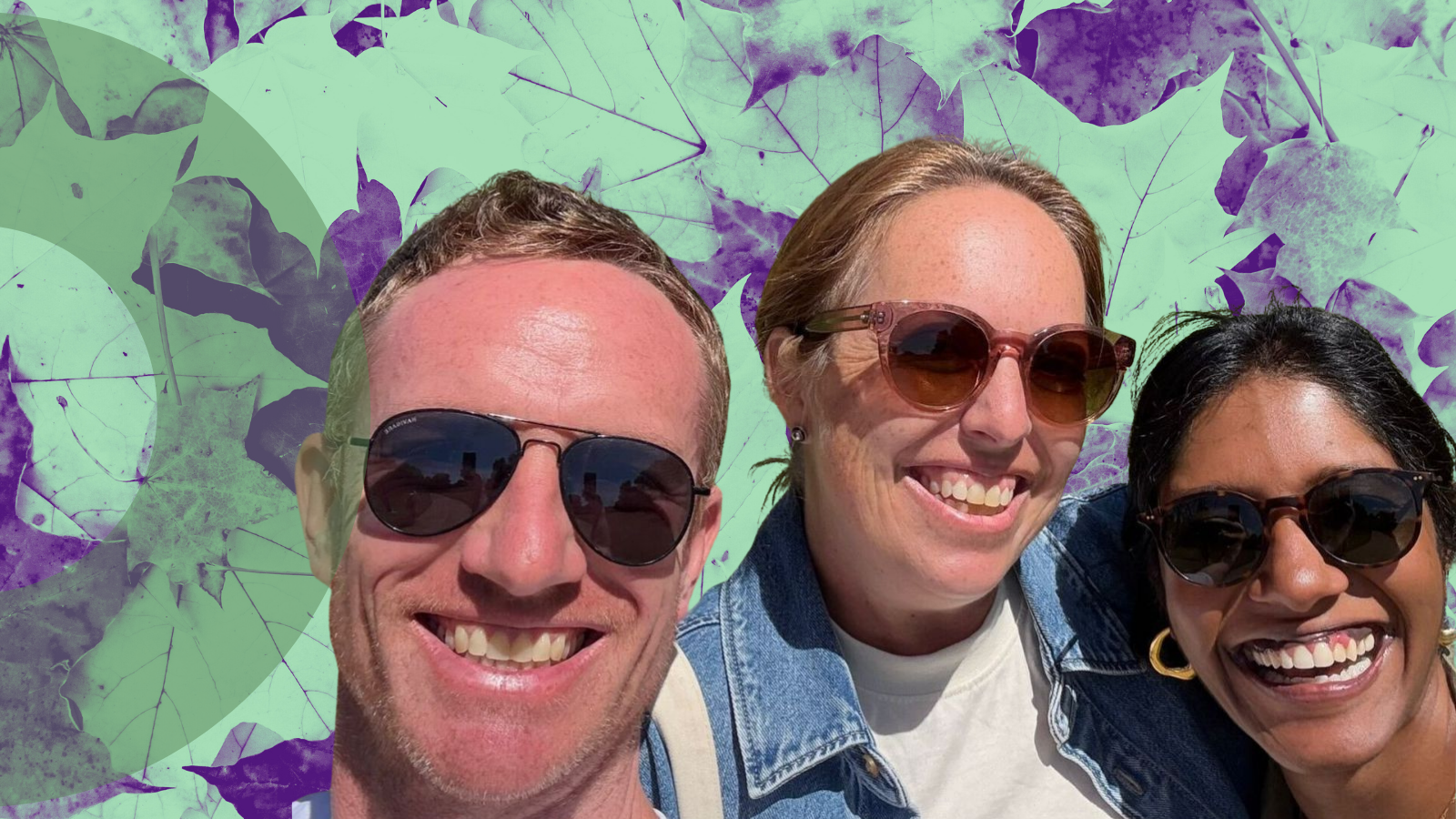
Visionary thinker Jon Alexander joins Nina Sharpe for a whistle-stop tour of Melbourne, learning firsthand about the innovative and inspiring ways everyday people are reshaping participatory democracy in our city.
"The simplest definition I offer of what it means to be a citizen is to step into your own agency" – Jon Alexander.
Jon Alexander knows a thing or two about people power. In his bookCitizens: Why The Key To Fixing Everything Is All Of Us, the former advertising exec turned regenerative thinker explains why we need to shift away from a culture of individualism and embrace the collective. Building agency and sustaining a community, he argues, is the key to successful democracy.
Jon’s thinking aligns deeply with the work we’re undertaking with 300,000 Streets. In fact, it’s been a guiding force in lasering our focus on how to help build and support more avenues for participatory democracy in Melbourne.
It was an honour to host Jon, visiting from the UK earlier this month, to show him firsthand the work that is happening in this space in our beautiful city. Why Melbourne? Jon’s work aligns deeply with that of Regen Melbourne. Here, he sees a city with the great potential to transform the collective. To build communities into active citizens and decision-makers.
Mi casa es su casa
Out the back of SPAN Community House in Thornbury, there are dozens of people of all ages, digging, planting and propagating. Bustling about large garden beds, framed by wild climbing pumpkins, Jon and I are approached by an effervescent elderly woman who introduces herself as “Spark”. A recent immigrant from Hong Kong, she tells us she’s been visiting SPAN’s garden club every week to help develop her English and, more importantly, find a community.
Guided inside the house by its manager Zoe Austin-Crowe, we find a small group gathered around the kitchen table learning how to cook Spanish food. Made with donated produce, the meals will be shared around to feed other SPAN visitors over the coming week.
Community or Neighbourhood Houses are spaces for community run by community. Or, as Zoe Austin Crowe describes them: “Spaces where contribution and support flow both ways. Where community isn’t something delivered, but something built together.”
SPAN is one of approximately 1000 Community Houses across Australia that serve multi-purpose functions, from running and facilitating support, assistance and education programs, to simply acting as a centralised community resource and meeting point.
The growing potential for Community Houses, as Melbourne faces new and complex challenges, still feels unrealised. A small garden area tucked between SPAN and an adjoining kindergarten serves as a great example of this. Now sheltered with native shrubs, seating and a misting system, the space had previously been overgrown and locked off to the public. By rethinking its potential, it now functions as a spot where anyone in the community can take pause on a hot day and seek relief from the sun. Already, it is opening up conversations about how Community Houses might come to function as central hubs for assisting communities with heat resilience as the climate crisis worsens.
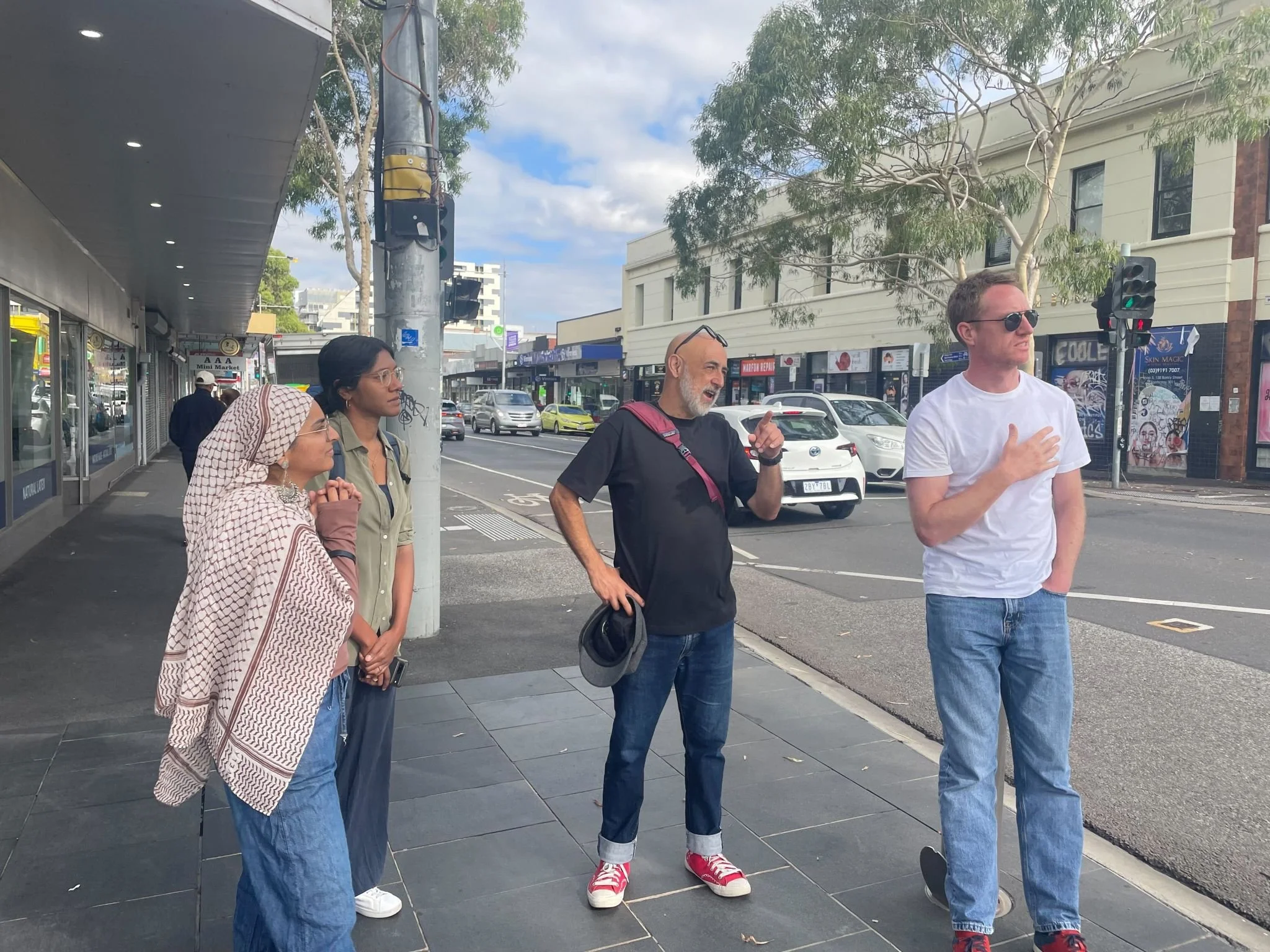
Mehak, Dheepa, Jorge and Jon touring Footscray.
Way out West
On a brightly-lit Melbourne morning, Jon and I join Jorge Jorquera, Coordinator at Borderlands Co-Operative, and Mehak Sheikh to walk the streets of Melbourne’s vibrant inner west and learn about the extraordinary community-driven work that is happening in Footscray and beyond.
Wandering along Nicholson Street Mall, which runs through the heart of Footscray, we learn of the challenges and opportunities faced by this often-overshadowed corner of our city.
Mehak speaks passionately of her work as a community leader running programs to support young people and newly arrived migrants in developing life and civic participation skills, helping centre those with the minimal agency back into the conversation. While Jorge details the emerging People’s Plan for Footscray, an ambitious project which seeks to bring people back into public decision-making. To prove how organised communities can build power and skills to bring about real change.
Jorge and Mehak’s work exemplifies the extraordinary potential for great change through the reintegration of community back into the oftentimes reactive and exclusive governmental decision making that is currently transforming these very streets. And not always for the better. It’s an inspiring look at how, with the right support, words and intention can fast transform into real action that benefits many.
One street at a time
On the other side of the city, Jon and I head to Ceres, a community garden and social enterprise in Brunswick East, to meet with a couple of people who are working within a more traditional democratic framework – local council – to try and bring about community-led change.
Merri-Bek council officers Zoe McMasterand Naklika Peiris are both experimenting, inspiring and building agency in the work they do, exploring what true reciprocity between councils and their communities can look like. A great example of this is the Ride and Stride program, which stands out as a blueprint of what it looks like when councils work alongside community to build spaces that reflect the wants and needs of those living there.
Ride & Stride aims to make it easier for communities to walk or ride safely to school and around their own neighbourhoods. It includes a new initiative called Open Streets, where schools remove car traffic for short periods of time during drop-off and pick-up times to help build community and make the space safe for open play. Its success has now inspired the newly-launched Street Party guidelines, which attempts to take this idea and broaden it out, making street reclamation available to anyone.
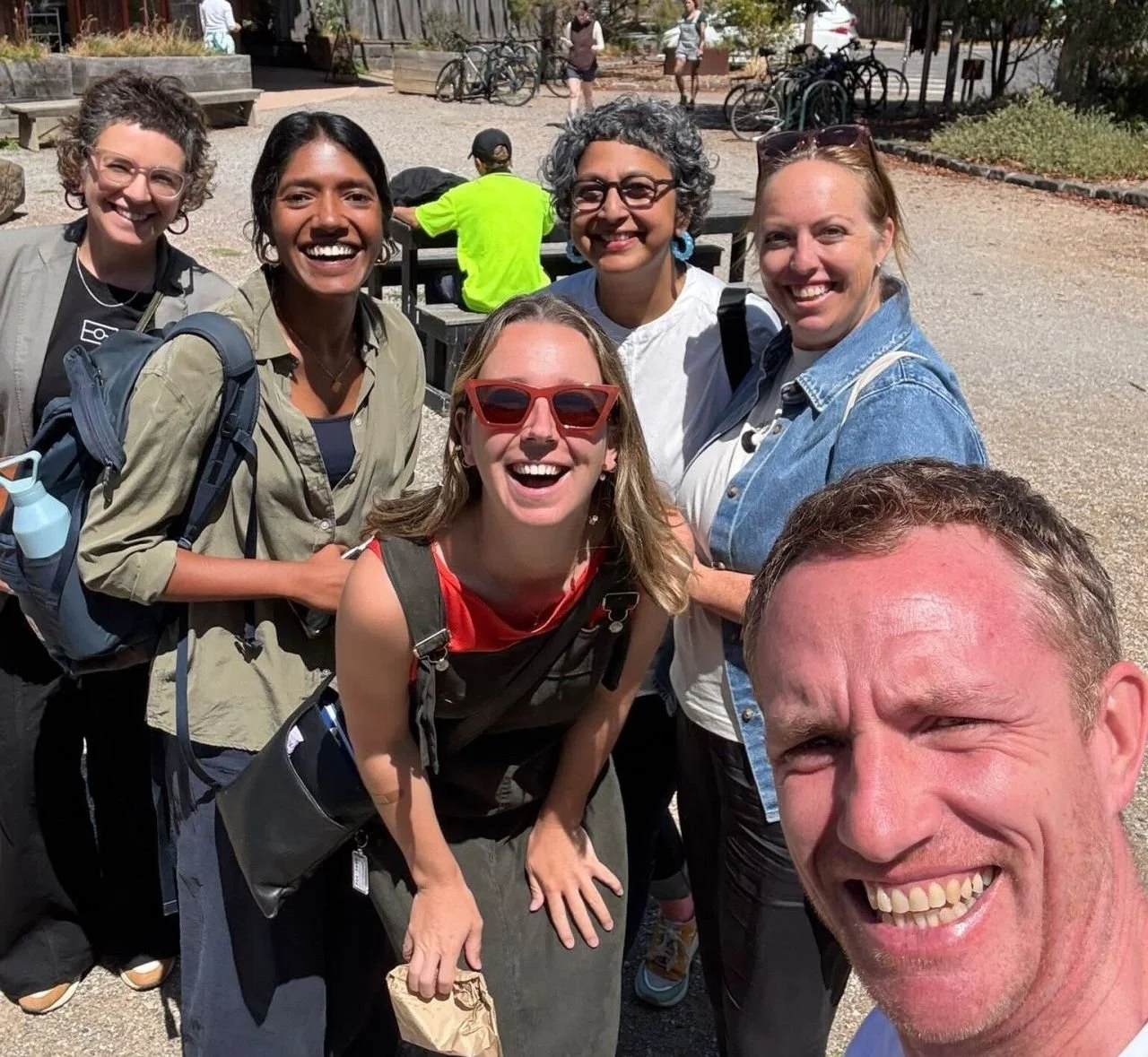
A morning at Ceres in East Brunswick.
The future is ours
Jon Alexander’s book Citizen has played a central role in inspiring and defining our work here at 300,000 Streets. So it was both uplifting and inspiring to be able to show him the small but mighty community movement here in Melbourne. To introduce him to the people on the ground doing the work and leading the transformation in different parts of the city. It was thought-provoking and helpful to hear his reflections on how this work mirrors or differs from that in other places, to learn more about what we’re getting right and what needs work.
We know that democratic participation is about more than just showing up at the ballot box. And, in these complex and challenging times, community and street transformation needs to be led and informed by the people it affects most.
In the words of Jon Alexander: “We are living through a moment when the old stories are breaking down. But a Citizen Future, rooted in the deep truth that all of us are smarter than any of us, is still possible.”
Subscribe to the Regen Gazette for news and views from the frontlines of Melbourne’s regeneration.