.webp)

Walking with the Birrarung
When I was young, Sundays were often spent walking along the Birrarung (Yarra River) with family and friends. Years later, reading Maya Ward's 'The Comfort of Water', I began to see the Birrarung differently, not as a familiar backdrop, but as a living being that gives, endures, and remembers.
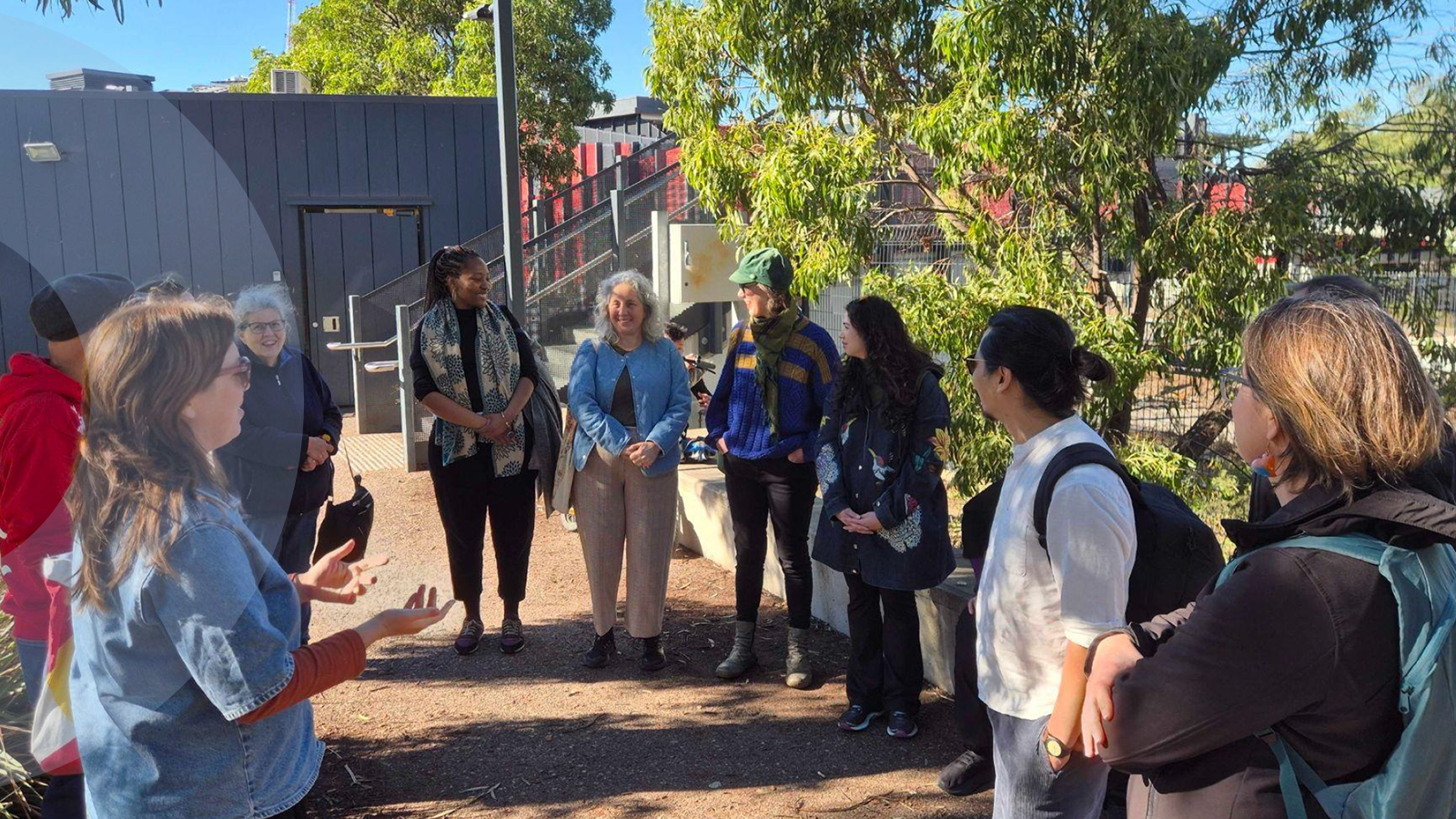
Early in my PhD, I joined a workshop in Warburton with Maya Ward and the Regen Melbourne team. Sitting beside the river, we shared our connection to the Birrarung. It was there I first felt the gravity of its history; once an abundant waterway, reshaped by colonisation, urbanisation, and now, the pressures of a changing climate.
After years of walking beside it, I entered the Birrarung at Deep Rock. The water was cold and unfamiliar. After a few moments, I felt the gentle current, the sun on my face, and my mind settle. The Birrarung met me where I was, as it has met many before.
Coming from a background in mathematics and optimisation, I was drawn to a question that has since become the heart of my PhD: How do we measure a living, changing river in a way that honours its complexity?
What does 'swimmability' mean?
My PhD is part of Regen Melbourne's broader Swimmable Birrarung Earthshot. We frame swimmability through five guiding principles:
Ways of Knowing recognises Indigenous, local, and scientific knowledge systems.
Community highlights people's connection to the river and shared responsibility to care for the Birrarung.
Water Quality captures the physical, chemical, and biological conditions that make the river safe for swimming.
Healthy Ecosystems reminds us that the Birrarung is an interconnected natural, cultural, and socio-economic system.
Intervention considers actions we can take, such as riverbank planting or stormwater management.
What do we measure, and how?
Early ecology saw ecosystems as closed, natural systems. Over time ecologists came to see them as open, dynamic, and often disturbed. People are now recognised as part of ecosystems. This social-ecological perspective is especially relevant for the Birrarung. Yet many water quality assessments focus mainly on E. coli. These indicators are critical for swim safety, but too narrow to reflect the river as a whole.
This project will draw on metrics spanning our guiding principles:
Ways of Knowing – Jack Norris reminds us that naming was an act of colonial possession. The river we know as the Yarra is Birrarung, "the river of mists". Restoring language to place is one practical expression of this principle. Tony Birch describes the river as a living archive, holding traces of colonial violence and of endurance.
Community and stewardship – reflected in how people relate to the river, their presence on and around the Birrarung, and visible acts of care.
Water Quality – indicators most relevant to public health, including clarity, temperature, bacteria, nutrients, and emerging contaminants such as PFAS, pharmaceuticals, pesticides, and microplastics.
Ecosystem Health – measures of biodiversity, habitat condition, and resilience to disturbances.
Interventions – practical steps towards restoration, such as native revegetation or stormwater management.
From Measurements to Meaning
Once datasets are established, the task is to move beyond raw measurements and draw out patterns and relationships that tell a story about the river. This project seeks to model the Birrarung as an interconnected system, incorporating features across different dimensions of river health, looking for patterns across space and time.
We will use Machine Learning, a branch of AI that identifies patterns in data, to evaluate river health and detect conditions associated with degradation. Environmental datasets are messy: samples are taken unevenly, with gaps across time and space. A substantial part of the work will be sourcing diverse datasets and managing their imperfections.
Returning to the River
In the end, this work returns to the Birrarung. Guided by the five principles, we seek to understand what data to collect, how to interpret it, and how to model the Birrarung as a living system, so that practical interventions can be guided to where they matter most.
If the Birrarung feels inviting again, if people choose to swim, it will be because many people listened well, measured wisely, and interpreted data with care, in ways that honour the river's living nature.
References
Birch, T. (2019). Walking and being. Meanjin, 78(4), 130–137.
Harriden, K. (2023). Working with Indigenous science(s) frameworks and methods. Methodological Innovations, 16(2), 201-214. https://doi.org/10.1177/20597991231179394
Norris, J. (2021). The Naming of the Yarra River as an Act of Colonialism. Agora vol. 56 no. 3, 59–67.

.png)