
How can our collective knowledge be in service to life?

Collaborative Research Ecosystems

Collaborative Research Ecosystems
Context

Barriers in the System

The global and local pressures on social and ecological systems call for new knowledge to inform effective, inclusive and regenerative responses. As part of this, we need challenge-led approaches to research that orient research systems to better respond and adapt to the urgency, scale and complexity of the conditions we face. Many researchers have been drawn to academia exactly by this sense of purpose; likewise, most universities' stated missions focus on public good outcomes and impact through their research, teaching and engagement.

Yet, at a systemic level, the academic research and innovation sector is falling short of its service orientation. Despite a desire to affect positive change, academia is often constrained by limited and competitive resourcing, narrowly-defined impact metrics and incentives and barriers to effectively distributing and translating new knowledge to inform practice and policy.

Our Response

What We're Doing

For research to consistently and effectively flow in service to social and ecological thriving, we need to transcend organisational and disciplinary silos, current incentive structures and understandings of who holds knowledge. This can enable and activate coherent research collaborations that both facilitate deep thinking and allow that thinking to guide action critically needed in practice.

Through our work with Collaborative Research Ecosystems, we are focused on both organising research in service of regeneration and unearthing research approaches that serve the wellbeing of people and planet by centring life, diversity and collaboration. This includes multi-sector collaborations to conduct and translate research, align incentives and resources with regenerative purposes and consider the role of relationality and systemic connection in research practices.

What we're asking

To guide our learning, we are asking questions about what is in our current system, what could be in the future and how to generate change towards that aspiration. In Collaborative Research Ecosystems, our overarching learning questions are:

WHAT IS

To what extent do current research structures and knowledge flows represent and support ambitions for a regenerative future?

WHAT COULD BE

What could collaborative research ecosystems in service of regeneration look like?

HOW TO

How might we create the conditions for knowledge flows and collaborative research to support collective action in service of the public good?

learning portfolio

Models & Instruments

How research and learning occur is generally driven by the resources and structures available to support it. This theme focuses on how we can orient existing and new research instruments and models towards holistic, public-good outcomes. Our learning questions within this theme include:

  • How might research pathways and resourcing instruments be oriented and coordinated to centre regeneration?
  • How might deploy creative approaches to research translation to increase its effectiveness in policy and practice?

Relationality & Collaboration

Research and learning in response to complex challenges is most effective when understood as a practice that incorporates diverse perspectives and a sense of deeper connection. This theme focuses on how we can establish purpose-driven and integrated, relational approaches to research collaboration. Our learning questions within this theme include:

  • How might we foster collaborative learning practices that activate research for the public good?
  • How might we strengthen our understanding of relationality and reciprocity through research practices?

Research Purpose & Coherence

Creating new knowledge is key to addressing our current social and ecological needs, but current definitions of research impact, and institutional silos, limit the potential for public-good outcomes at-scale. This theme focuses on how we can integrate research effectively into challenge-led work and align expertise with critical social and ecological needs. Our learning questions within this theme include:

  • How might we activate research in service of challenge-led innovation?
  • How might we reshape the research ecosystem so its incentives respond to the pace and urgency of real-world challenges?
Large crowd at the City Portrait for Greater Melbourne launch in a heritage brick venue with purple lighting
Indigenous Knowledge and Regenerative Practice

Indigenous Knowledge and Regenerative Practice

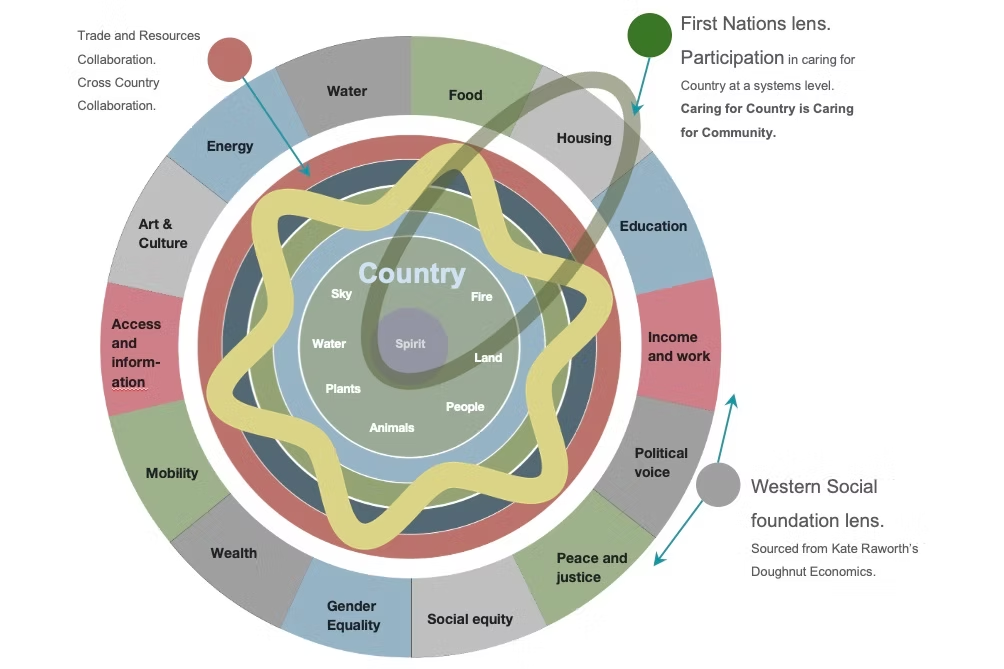
Alignment of the Australian Indigenous Doughnut with Regen Melbourne's frameworks and practices

Relational Ecology

Relational infrastructure to orient knowledge flows in service of public good

Climate Change Exchange

Cross-sectoral platform facilitating collaboration in climate change adaptation
Transforming the Public Plate

Transforming the Public Plate

A Menu of Options for Public Food Procurement That Nourishes People, Place and Planet
Climate Resilience in Food Systems

Climate Resilience in Food Systems

Building capability and cross collaborations in climate resilience and food systems spaces
Resilience In-house

Resilience In-house

Resilience planning in neighbourhood houses in the West
Connected Corridors

Connected Corridors

Transforming 1600 km of underutilised public land into an ecological network that reconnects communities and ecosystems.
Riverbank

The Riverbank

A financial backbone for the coordination of investment in service of the life-force of Melbourne

Stormwater Sources

Innovative visualisation of stormwater sources, flows and river health
Tomorrow's River

Tomorrow's River

Reimagining our connection with the Birrarung Yarra River
Systemic Risks on the River

Systemic Risks on the Birrarung

Centring the Birrarung Yarra River to surface systemic risks and the economics of regeneration
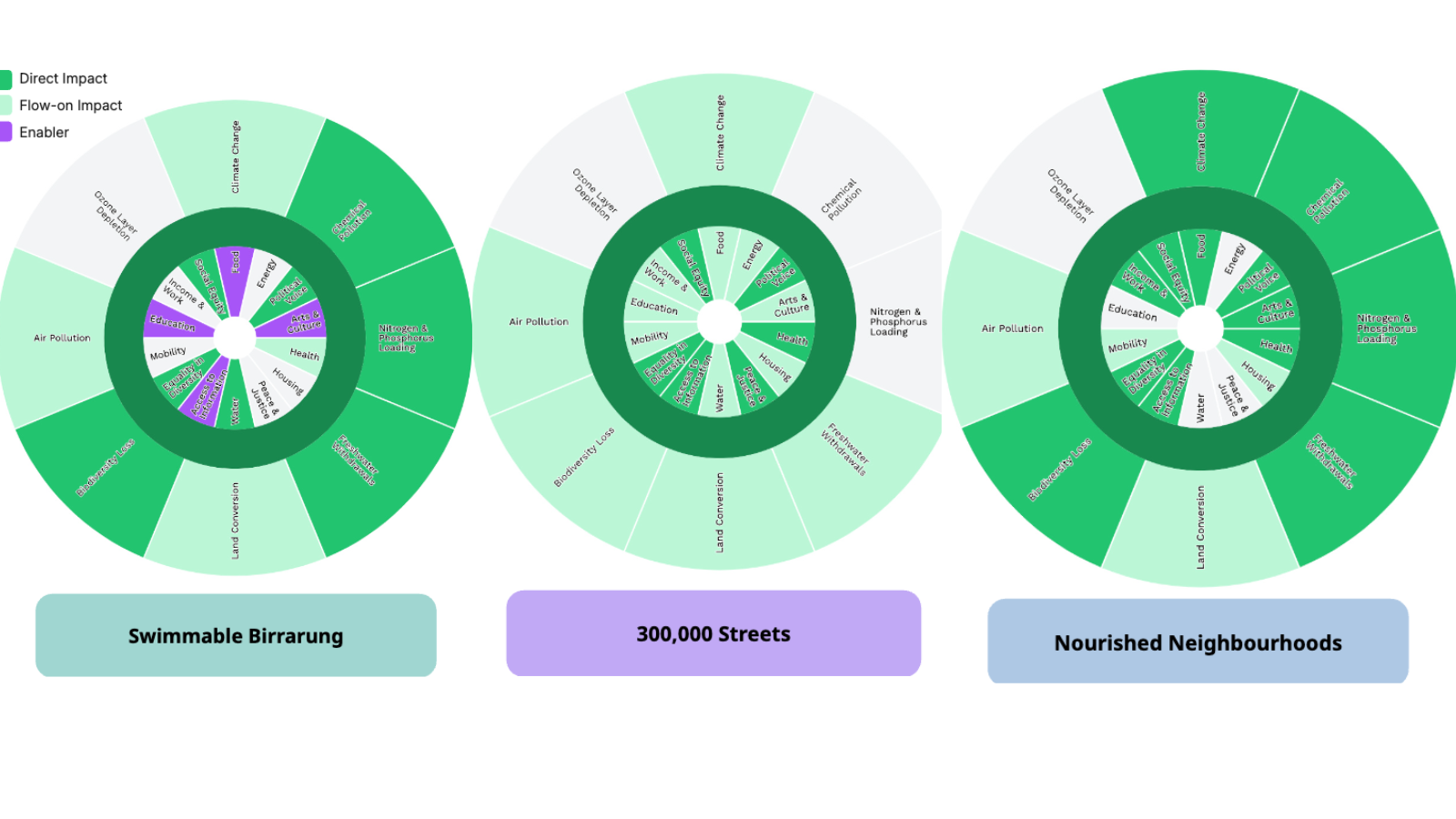
Data Optimising for Swimmability

Data Optimising for Swimmability

Optimising data for decision making and swimmability along the Birrarung Yarra River