.webp)

'Field Notes' is a fortnightly column in which Regen Melbourne's Lead Convenors provide on-the-ground updates and insights from their work and focus areas.
As she continues to explore emerging governance practices in her role as New Urban Governance Lead, Caroline Sanz-Veitch has been spending time in the field, learning from community and cultures close to her. Here, she shares some of the insights she's started to glean — and the importance of understanding how different people and groups relate to a place.
Lately I've been grappling with questions around what it means to belong or connect to a place, and how our sense of responsibility and care for that place, and the people in it, develops over time. As my focus has shifted to more deeply interrogating our current models of urban governance, and even the concepts of governance itself, I keep being drawn back to first wanting to understand how people relate to a place in order to be able to make collective decisions about what happens there.
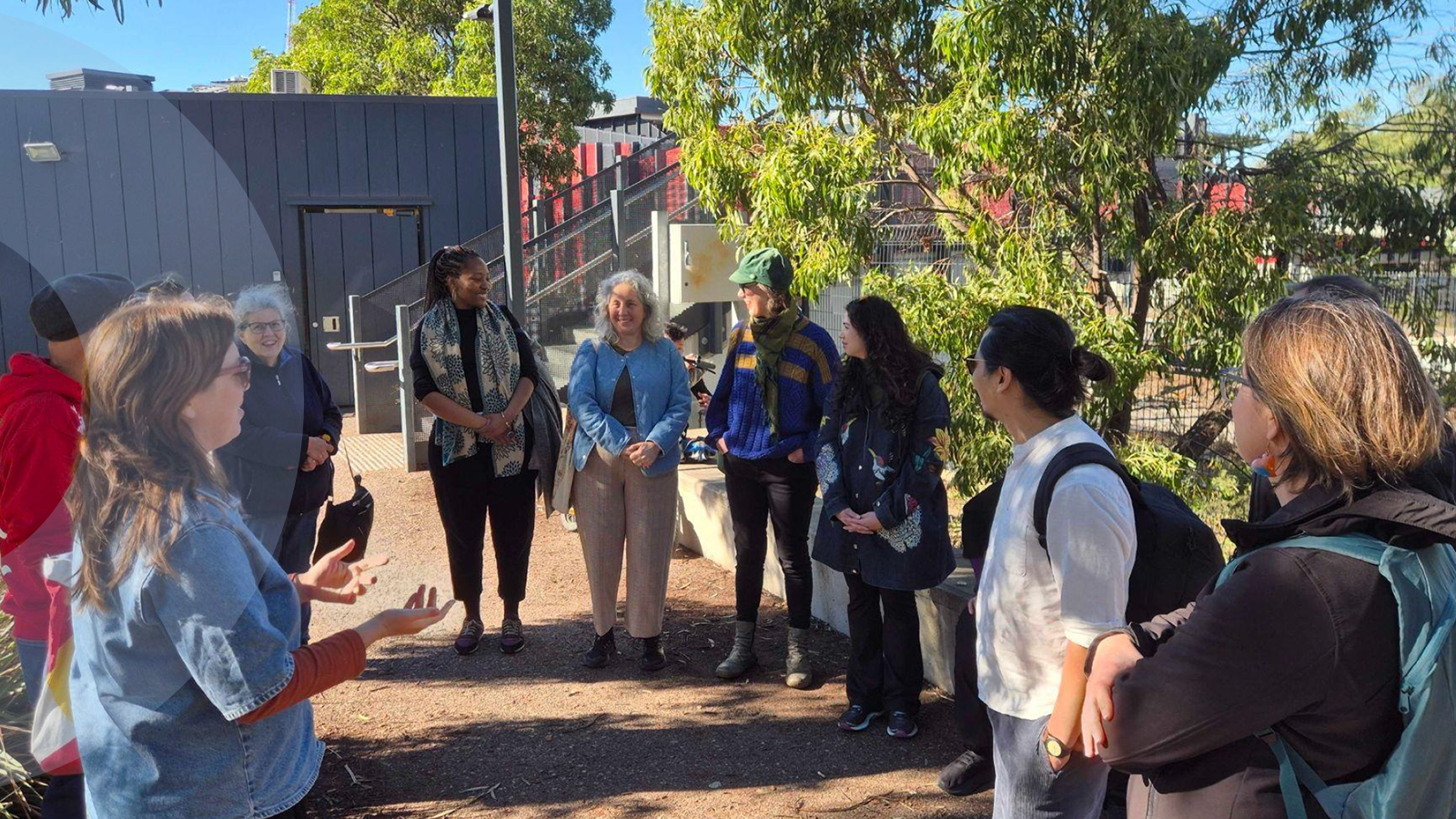
Perhaps due to my ongoing fascination with ethnography, I decided to explore these questions out in the field. I sought to immerse myself in different forums that were engaging with customs, practices or rituals that surfaced alternate ways of understanding how we see ourselves within a place and the roles we have in relation to it. Incidentally, I kept finding myself drawn to First Nations' conceptualisations and wisdom surrounding these questions, and in particular some of their age-old practices of participation and collaboration.
During this immersion experiment, I turned to communities I was already a part of as well as welcoming invitations to newer ones that were tackling some of these questions.
"In a time of endless meetings and overcrowded calendars, many of us have lost the ability to be intentional about how we come together."
Over this time I was introduced to, and particularly influenced by, a series of approaches or concepts that seemed to ground people in place as well as in connection with others:
Wayapa, as a practice both facilitates sharing of cultural knowledge but also holds space to connect to each other and to country. It was also introduced to me as a toolkit that helps us learn from nature.
Ho'oponopono, a forgiveness and reconciliation practice that roughly translates to returning things to balance and making things right. This practice helps us recognise tensions both within us and between ourselves and others.
Deep time diligence, as a way of making decisions with a deep relationship to time, and collective wisdom.
The Va, a multi-faceted concept part of Samoan and Maori cultures that describes the spiritual and social relations between people — particularly drawing attention to the 'in between space' that is seen as a relational space rather than an empty or separational space.
Here are a couple of things I believe they can teach us about community participation and governance:
Relationality unlocks deeper understanding
In a time of endless meetings, overcrowded calendars and a constant feeling of racing between engagements, many of us have lost the ability to be intentional about how we come together. These practices have reminded me of the importance of considering not just what we are hoping to discuss, but how we go about the discussion. If we seek to have more participation in local decision-making, perhaps first we need to start looking at how we are creating space for building connection, understanding and relationships with each other.
Recognising our responsibility to place
Throughout this immersion, I realised that people were also considered as 'in relation to' something, seldom in isolation. When we only focus on people as individual entities, we often forget about the reciprocity that is inherent in how we exist within a place. If we think about ourselves as in relation to others or the environment we exist within, it encourages us to recognise our responsibility to that entity and how we are each contributing to each other's existence.
This immersion and learning process has been profound in supporting and stretching my intuition around the significance of relationality in creating change and making meaningful decisions. It has me feeling hopeful for the possibilities we are capable of unlocking if we can harness the potential of the collective and the power of connection.

.png)